
Fact Check: Is Rainwater Safe to Drink? Only After Proper Filtration and Treatment
The claim may be misleading. While rainwater has the potential to be a clean source, it is not safe to drink without proper collection, filtration, and purification, as it can pick up contaminants from surfaces during storage.
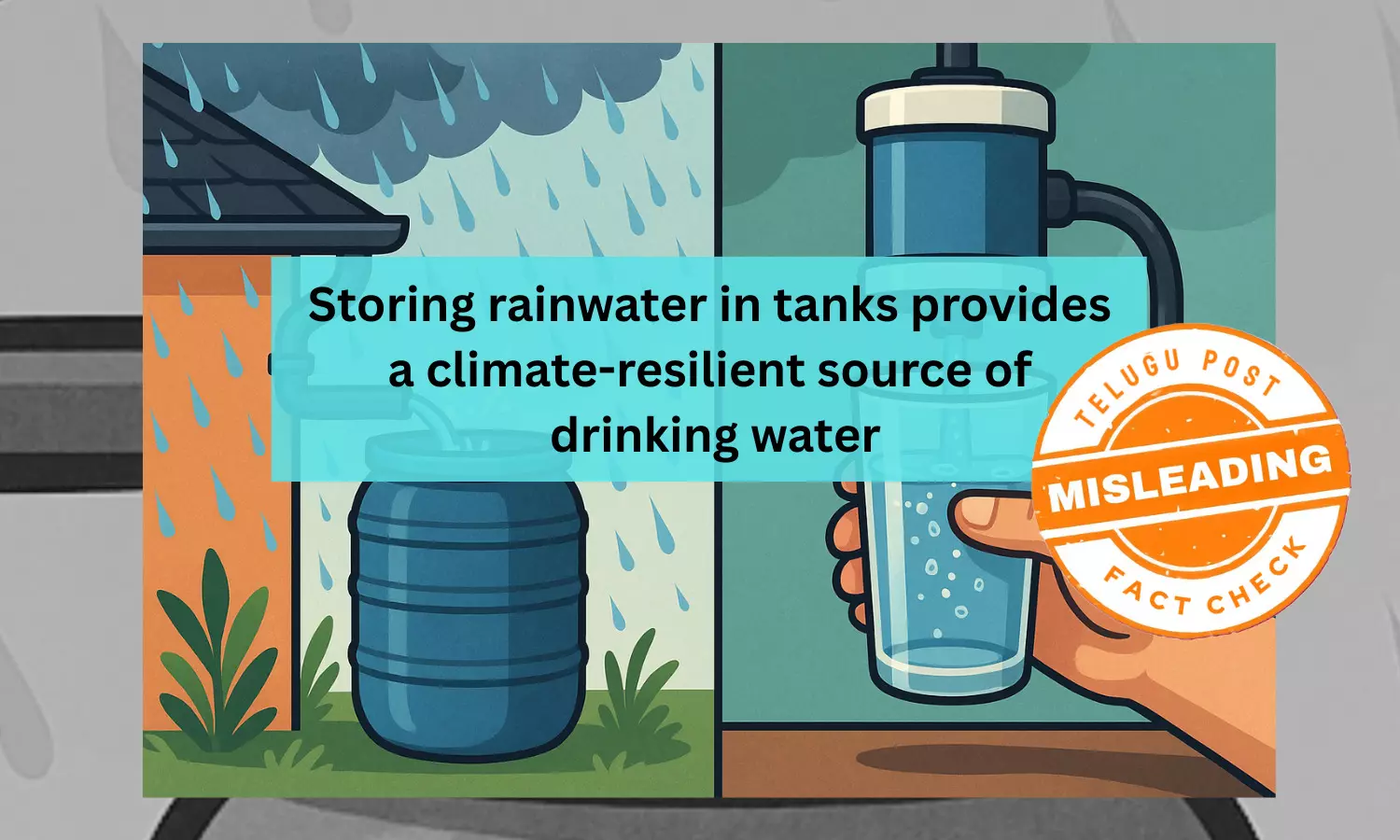
Claim :
Storing rainwater in tanks provides a climate-resilient source of drinking water.Fact :
The claim is misleading. Rainwater can be made drinkable with proper collection, filtration, and purification, but on its own, it may contain dirt, bacteria, or chemicals from surfaces it contacts.
Water scarcity, tough terrain, and delays in state funding are slowing progress under the Jal Jeevan Mission (JJM), the Centre’s flagship programme to provide tap water to every rural household. The government has pushed the mission’s deadline from 2024 to 2028, citing several implementation hurdles. In a written reply in the Lok Sabha, Minister of State for Jal Shakti V. Somanna said states have reported a range of issues—lack of reliable water sources in drought-prone and desert areas, groundwater contamination, scattered rural habitations, and delays in statutory clearances. Rising construction costs and a shortage of skilled workers at the local level have further affected the rollout. Some states have also failed to release their share of funds on time, causing project delays.
To address these problems, the Centre has launched the Nal Jal Mitra programme to train local workers and established programme management units at state and district levels to improve execution.
Amid this, a text is surfacing on social media claiming: "Storing rainwater in tanks provides a climate-resilient source of drinking water."
The claim link can be found here, and a screenshot is provided below.
Fact Check:
The claim is misleading. Rainwater used to recharge a borewell is not safe to drink unless it is properly treated after extraction.
While discussing this claim with a water expert, he informed us that rainwater can be a valuable source of drinking water if properly managed. While rainwater itself is relatively clean, it can become contaminated as it falls and flows over roofs or into storage tanks, picking up dirt, bacteria, chemicals, or debris.
To make it safe for consumption, rainwater should be collected from clean roofing surfaces, and first-flush systems should be used to divert initial runoff. It must then be filtered to remove particles and disinfected through boiling, UV treatment, or chlorination to eliminate pathogens. Proper storage in clean, covered tanks is also essential to prevent contamination and mosquito breeding.
Untreated rainwater stored in tanks is not always safe to drink. However, with the right precautions, it can be made safe and suitable for household use.
An engineer of Community Harnessing and Harvesting Rainwater Artificially from Terrace to Aquifer said, rainwater harvested and sent into a borewell is not immediately safe for drinking. While the process helps recharge the underground aquifer, it does not purify the water for direct consumption. Rainwater can carry dust, bird droppings, chemicals, and other contaminants from rooftops and the atmosphere. Even with basic filtration before recharge, the water mixes with existing groundwater in the borewell, which may already be contaminated. Since there’s no control over the final water quality, it must be tested regularly. To make the water safe for drinking, proper purification such as UV treatment, boiling, or reverse osmosis is essential after extraction. Therefore, while rainwater harvesting through borewells is effective for water conservation, the water should never be consumed without adequate treatment.
While searching with the keywords, we found that Smart Water Online had published an article on it.
In the article, Smart Water Online mentioned: If you are planning on collecting rainwater for drinking, then you will need to put in place a number of filtration systems to ensure that the water is safe to drink.
Potable water—water you plan to drink, cook with or shower in—must be filtered from all debris and also pathogens and microbial pollutants before it is considered safe for consumption. There are a number of ways you can filter the rainwater that falls onto your roof before it enters your tank and before it enters your home and it is often necessary to use a combination of these filters to ensure that your water is clean and safe.
Whilst the rainwater that falls directly from the sky is relatively safe to drink, in order to collect the rainwater in your tank, it must first land on the roof of your property, and this is where it can pick up debris, pathogens, and microbial pollutants that can make it unsafe for drinking.
As the rainwater sits in your tank, there is also the possibility that bacteria can develop here as well, so it is important to treat the water in your tank as well as add another layer of filtration before the water leaves your tank and enters your property.
There are many people that would say that rainwater is the purest form of drinking water and therefore makes it the optimal drinking water; however, not all rainwater is created equal.
There are a number of factors that determine the quality and cleanliness of the water that falls from the sky, so when we are answering the question “is fresh rainwater the optimal drinking water?”, there are a number of factors that we need to take into consideration.
As rain falls from the sky, it absorbs pollution, pollen, mould, and other contaminants including dust and low levels of bacteria. If these are not filtered out of your rainwater before you use it—especially for drinking—it can be unsafe. If, however, you can collect or drink rainwater directly from the sky, without it touching any surface, then rainwater can be considered the optimal drinking water in most places around the world.
Hence we found the claim may be misleading. While rainwater has the potential to be a clean source, it is not safe to drink without proper collection, filtration, and purification, as it can pick up contaminants from surfaces during storage.