
Fact Check: Norway’s Deforestation Ban Misunderstood — No Nationwide Prohibition in Place
The claim is Misleading. While Norway has taken significant steps toward environmental sustainability, becoming the first country to commit to a zero-deforestation public procurement policy, it has not implemented a nationwide ban on deforestation. The claim, though rooted in real progress, overstates the actual policy.
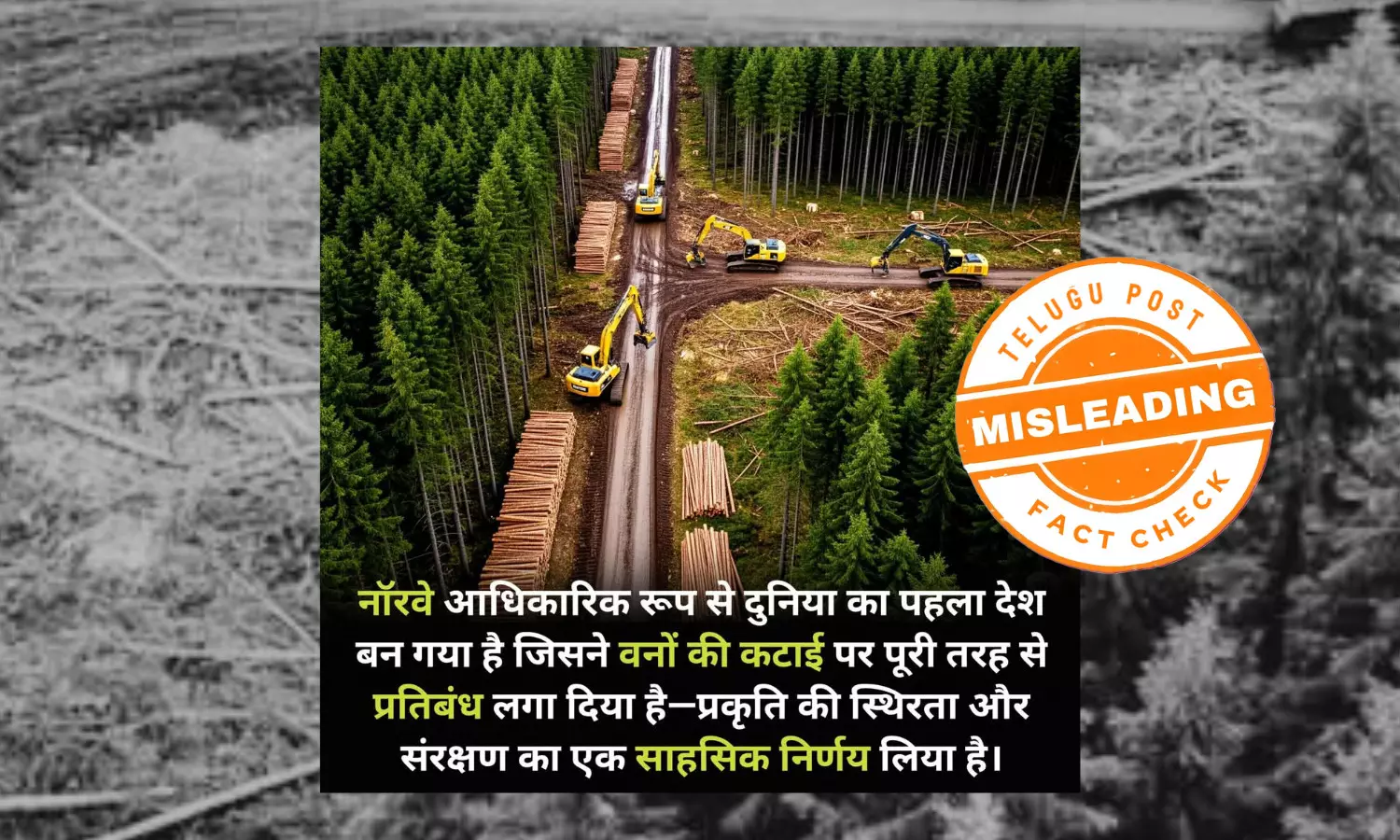
Claim :
Norway has officially become the first country in the world to completely ban deforestation – a bold decision to promote sustainability and preservation of nature.Fact :
The claim is Misleading. Norway did pioneer a zero-deforestation procurement policy, making it the first country to do so, but it has not enacted a universal ban on deforestation across all economic activity or inside its own borders.
EUROPE’S ban on goods linked to deforestation is facing more pressure from within the continent, with 18 of 27 European countries writing to the European Commission calling for significant changes to the legislation. The letter follows a resolution made by the European Parliament last week to walk back the legislation for countries where forest area is stable or increasing – before it comes into effect on December 30 this year.
Under its current form, Australia and most other countries in the world are declared a low risk of deforestation, with only four countries (Belarus, Myanmar, North Korea, and Russia) being a high risk and about 50 countries in the standard risk category. While the European Commission is not obliged to act, there is now a push from the European Parliament to add a “no-risk” or “negligible risk” category for countries with stable or increasing forest area – to ease the administrative burden on exporters and importers.
The regulation in its current form does not sufficiently take into account countries with effective forest protection and a negligible risk of deforestation. Instead of targeting deforestation where the risk is highest, the regulation imposes disproportionate bureaucratic obligations on countries, where deforestation is demonstrably insignificant.
Amid this, a text is surfacing on social media claiming: "Norway has officially become the first country in the world to completely ban deforestation – a bold decision to promote sustainability and preservation of nature."
Fact Check:
The claim is Misleading. Norway was the first to stop buying products linked to deforestation, but it hasn’t fully banned deforestation in the country.
While discussing this claim with a climate expert, he informed us that, while Norway has made commendable strides in environmental policy — most notably by becoming the first country to adopt a zero-deforestation public procurement policy — this does not amount to a full national ban on deforestation. The policy specifically targets government purchases, ensuring that products like palm oil, soy, and timber do not contribute to tropical deforestation. However, it does not prohibit deforestation within Norway or across all sectors. Therefore, while the move is pioneering and symbolically powerful, the claim that Norway has “completely banned deforestation” exaggerates the reality.
While searching with the keywords, we found that Regjeringen had published an article on it.
In the article Regjeringen mentioned: More recently, in July 2025, Norway announced it will implement parts of the EU’s Deforestation Regulation, applying to products at high risk of contributing to tropical deforestation (such as certain timber, coffee, rubber, cocoa, and palm oil). However, it does not yet cover agricultural goods like beef and soy under the EEA framework, and exports and domestic production are exempt unless covered by future national rules.
In the article Regjeringen also mentioned, the Government has decided that agricultural products such as beef and soya, as well as exports to countries outside the EEA, will be excluded from implementation, as this falls outside the scope of the EEA Agreement. A proposal for how the EU Deforestation Regulation will be implemented nationally will be submitted for public consultation. At the same time, the Government will explore how the objectives of the EU regulation best can be achieved through national rules for the parts not covered by the EEA Agreement, such as beef and soya.
The EU Deforestation Regulation was adopted by the EU in 2023, and will apply from December 30, 2025.
Hence we found that the claim is Misleading. While Norway has taken significant steps toward environmental sustainability, becoming the first country to commit to a zero-deforestation public procurement policy, it has not implemented a nationwide ban on deforestation. The claim, though rooted in real progress, overstates the actual policy.